期刊介绍
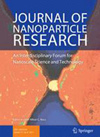
The objective of the Journal of Nanoparticle Research is to disseminate knowledge of the physical, chemical and biological phenomena and processes in structures that have at least one lengthscale ranging from molecular to approximately 100 nm (or submicron in some situations), and exhibit improved and novel properties that are a direct result of their small size.
Nanoparticle research is a key component of nanoscience, nanoengineering and nanotechnology.
The focus of the Journal is on the specific concepts, properties, phenomena, and processes related to particles, tubes, layers, macromolecules, clusters and other finite structures of the nanoscale size range. Synthesis, assembly, transport, reactivity, and stability of such structures are considered. Development of in-situ and ex-situ instrumentation for characterization of nanoparticles and their interfaces should be based on new principles for probing properties and phenomena not well understood at the nanometer scale. Modeling and simulation may include atom-based quantum mechanics; molecular dynamics; single-particle, multi-body and continuum based models; fractals; other methods suitable for modeling particle synthesis, assembling and interaction processes. Realization and application of systems, structures and devices with novel functions obtained via precursor nanoparticles is emphasized. Approaches may include gas-, liquid-, solid-, and vacuum-based processes, size reduction, chemical- and bio-self assembly. Contributions include utilization of nanoparticle systems for enhancing a phenomenon or process and particle assembling into hierarchical structures, as well as formulation and the administration of drugs. Synergistic approaches originating from different disciplines and technologies, and interaction between the research providers and users in this field, are encouraged.
期刊语言要求
Language
Presenting your work in a well-structured manuscript and in well-written English gives it its best chance for editors and reviewers to understand it and evaluate it fairly. Many researchers find that getting some independent support helps them present their results in the best possible light.
投稿要求
CITESCORE
| CiteScore | SJR | SNIP | CiteScore排名 |
|---|
| 4.00 | 0.469 | 0.517 | | 学科 | 分区 | 排名 | 百分位 | 大类:Mathematics
小类:Modeling and Simulation | Q2 | 119 / 361 |
| 大类:Mathematics
小类:Condensed Matter Physics | Q2 | 196 / 443 |
| 大类:Mathematics
小类:General Chemistry | Q2 | 184 / 404 |
| 大类:Mathematics
小类:Atomic and Molecular Physics, and Optics | Q2 | 112 / 232 |
| 大类:Mathematics
小类:General Materials Science | Q3 | 231 / 460 |
| 大类:Mathematics
小类:Bioengineering | Q3 | 108 / 163 |
|
|
WOS期刊JCR分区
WOS分区等级:
2区| 按JIF指标学科分区 | 收录子集 | JIF分区 | JIF排名 | JIF百分位 |
| 学科:CHEMISTRY, MULTIDISCIPLINARY | SCIE | Q2 | 118/239 |
|
| 学科:MATERIALS SCIENCE, MULTIDISCIPLINARY | SCIE | Q3 | 275/460 |
|
| 学科:NANOSCIENCE & NANOTECHNOLOGY | SCIE | Q3 | 105/147 |
|
| 按JCI指标学科分区 | 收录子集 | JCI分区 | JCI排名 | JCI百分位 |
| 学科:CHEMISTRY, MULTIDISCIPLINARY | SCIE | Q3 | 148/241 |
|
| 学科:MATERIALS SCIENCE, MULTIDISCIPLINARY | SCIE | Q3 | 344/462 |
|
| 学科:NANOSCIENCE & NANOTECHNOLOGY | SCIE | Q4 | 112/147 |
|
期刊分区表预警名单
2025年03月发布的2025版:不在预警名单中
2024年02月发布的2024版:不在预警名单中
2023年01月发布的2023版:不在预警名单中
2021年12月发布的2021版:不在预警名单中
2020年12月发布的2020版:不在预警名单中
中科院2025年3月升级版
点击查看中国科学院期刊分区趋势图| 大类学科 | 小类学科 | Top期刊 | 综述期刊 |
|---|
| 材料科学 3区4区1区 | CHEMISTRY, MULTIDISCIPLINARY
化学:综合 | 1区1区4区 | MATERIALS SCIENCE, MULTIDISCIPLINARY
材料科学:综合 | 3区3区4区 | NANOSCIENCE & NANOTECHNOLOGY
纳米科技 | 2区3区4区 |
| 否 | 否 |
中科院2023年12月旧的升级版
| 大类学科 | 小类学科 | Top期刊 | 综述期刊 |
|---|
| 材料科学 2区4区1区 | CHEMISTRY, MULTIDISCIPLINARY
化学:综合 | 4区3区4区 | MATERIALS SCIENCE, MULTIDISCIPLINARY
材料科学:综合 | 3区3区4区 | NANOSCIENCE & NANOTECHNOLOGY
纳米科技 | 3区3区4区 |
| 否 | 否 |

 微信扫码加好友
 QQ扫码加好友